
- MySQL
Cropped 17 June 2026: Coral reef ‘hope’ | Ocean talks | Plant flowering times ‘shift’
Date:2010-12-5 17:23:32 Author:How-To Guides Source:DevOps Views: Comments:0Summary:We handpick and explain the most important stories at the intersection of climate, land, food and naWe handpick and explain the most important stories at the intersection of climate, land, food and nature over the past fortnight.
This is an online version of Carbon Brief’s fortnightly Cropped email newsletter.
Subscribe for free here.Key developments
Ocean talks
MAKING WAVES:African and Commonwealth countries issued a “call to action” to implement the High Seas Treaty at the Our Ocean Conference in Kenya this week, reported the Associated Press. The summit, which ends on 18 June, is focused on ocean issues including “climate change, biodiversity and pollution”, said the newswire. The UK government announced £13.9m in marine-related funding at the summit.
OCEAN ‘STRAIN’: Climate change, pollution, overfishing and biodiversity loss are putting oceans under “severe strain”, according to a UN report. The third “world ocean assessment” noted that conservation efforts have also “grown”, including through “nature-based solutions, ecosystem restoration and sustainable management techniques”. Meanwhile, another UN report said that fisheries and aquaculture production reached an all-time high of 235m tonnes in 2024.
OBSERVATION ISSUES:Scientists told the Guardian that the Trump administration’s plan to dismantle a key ocean-observation system run by the US would “severely degrade” the accuracy of weather forecasts around the world. Several Democratic and one Republican lawmaker pushed back against the plan to get rid of the system, reported the Associated Press. [For more, see the first edition of Cited, Carbon Brief’s newsletter on climate science.]
Plant and fungi update
OFF-KILTER: Plant flowering times have “shifted significantly” over the last century, according to an AI-assisted analysis of 8m “digitised herbarium specimens” in the latest “state of the world plants and fungi” report from the Royal Botanic Gardens Kew. The report stated there have been “both advances and delays” in flowering date, with a median shift of 2.5 days per decade in either direction. The greatest variation was observed in the tropics, it added.
‘NEW ERA’:The report highlighted that Kew recently completed a digitisation of 7.4m herbarium and fungarium specimens in its collection. The ongoing digitisation of specimens around the world, alongside AI technology, could “transform understanding of biodiversity loss and climate change and pave the way to resolving these seemingly intractable crises”, it said.
EXTINCTION RISK: In its coverage of the report, the Guardian said that AI and digitalisation could help scientists document “vital” plant species “before they vanish”. About 40% of the world’s “assessed” 70,000 plant species are at risk of extinction, while a further 330,000 are yet to be analysed, according to the newspaper. The situation for fungi is “even more stark”, it reported, with 90% of an estimated 2m species still “unknown to science” and less than 1% of known species assessed for extinction risk.
News and views
- BEEF TRACKS:A “landmark” law in Colombia requiring the beef industry to prove supply chains are deforestation-free has taken effect, reported the Associated Press. The measure is part of efforts to “reverse decades of forest loss, much of it driven by the expansion of cattle ranching into previously forested areas”, noted the newswire.
- CONTINGENCY PLAN: With El Niño conditions officially confirmed as underway, the Indian government called for an “overhaul” of agricultural districts’ plans for managing the impact of below-normal rainfall on crops, reported Down to Earth. Around 150-200 districts have been identified as “most critical” based on projections, the outlet noted.
- MEATIER: Global meat supply has increased fourfold in the past six decades, according to a UN report covered by the Guardian. Agriculture’s “planet-heating emissions are forecast to rise by 7.6% over the next decade” as food production continues to grow, the newspaper said.
- TREES, NOT TARMAC: Kenya’s former chief justice, David Maraga, was among a number of protesters arrested in Nairobi for demonstrating against plans to turn 75 acres of Nairobi National Park into a car park, reported Kenya’s Daily Nation. Demonstrators were en route to deliver a petition to Kenya’s Wildlife Service when they were interrupted by anti-riot police officers, according to the newspaper.
- MANGROVES BACK, ALRIGHT:A new study covered by BBC News found that mangrove forests are “staging an unexpected comeback” globally. The broadcaster said mangroves had been “declining rapidly as they were cleared for fish farms and housing”, but the world is now “gaining more mangroves than it has been losing”.
- ‘LIMITED’ PROGRESS: Some 59% of the world’s largest financial institutions do not have a deforestation policy in place, according to the latest “forest 500” report from Global Canopy. The report – which assesses the 150 financial institutions that provide the most financing to the 500 companies with the “greatest influence” on deforestation – described finance sector progress on forest loss in 2025 as “limited”.
Spotlight
Coral reef ‘hope’
This week, Carbon Brief reports on research estimating coral reef resilience.
New research offers a sliver of “hope” that 30% of the world’s coral reefs could be “resilient” against the harmful effects of climate change.
The study, which is in the final stages of peer review and due to be published soon, identified swathes of reefs that have the best potential to withstand and recover from marine heatwaves and other stressors.
Climate change is a major threat to the survival of coral reefs. In a 2018 report, the UN’s science body warned that reefs could decline by an additional 70-90% at 1.5C of warming and as much as 99% under 2C.
The areas of potentially resilient reefs identified in the new study span almost 166,000 square kilometres – an area twice the size of Scotland.
These reefs are spread across 71 countries and 100 territories, but 61% are found in the territorial waters of just five nations – Australia, the Bahamas, Cuba, Indonesia and the Philippines.
The lead study author, Dr Kyle Zawada from Macquarie University in Australia, told Carbon Brief that the research shows the areas that could most likely “persist through climate change”. He added:
“[Coal reefs] are obviously in dire straits – but that’s not to say there are not pockets of resistance and pockets of resilience.”
Fewer than 30% of the reefs deemed to be the most climate-resilient are contained in protected or conserved areas, the study noted.
The map below shows a snapshot of the findings, highlighting the Great Barrier Reef off the north-eastern coast of Australia. The light pink areas are regular reefs, while the slightly darker pink are “climate-resilient” reefs.
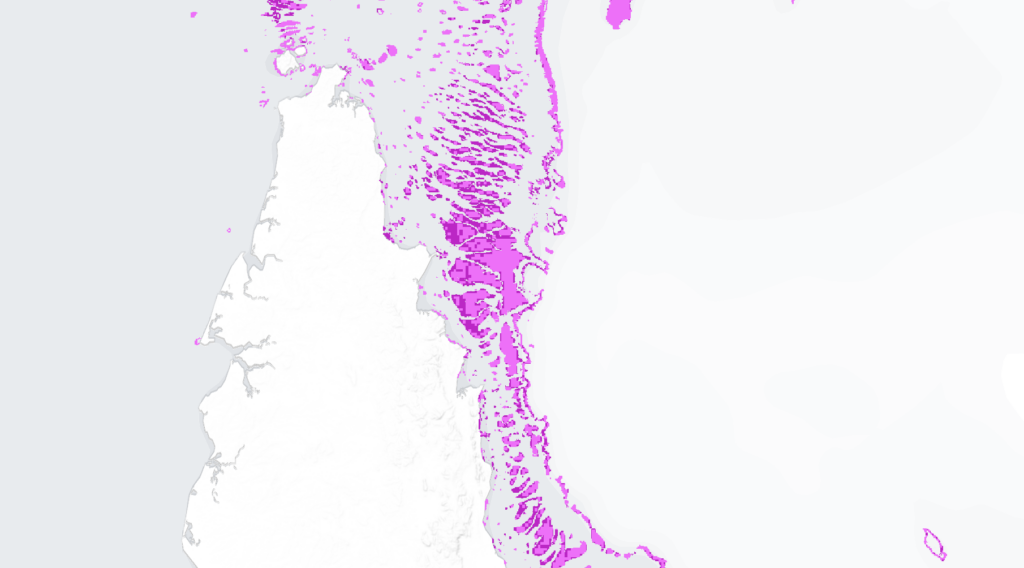
Map of coral cover at the Great Barrier Reef off the coast of Queensland, Australia. Source: SkyTruth Reef maps
The team, led by researchers from Macquarie University and the Wildlife Conservation Society, used the findings from more than 45,000 research surveys on corals over 1960-2025 in modelling simulations to create a map of coral cover around the world in 2020 and projections for 2050.
The modelling looked at various scenarios of future emissions and the researchers developed criteria to determine which reefs could be best positioned to survive or recover from extreme events and higher temperatures.
This specified that, for example, larger-sized reefs and those with a wide diversity of coral species tend to be more resilient than smaller areas with a lower variety of coral.
Zawada told Carbon Brief that the study does not replace real-life observations of how reefs respond to extremes. But, he added, it offers a “good guess” of areas to protect:
“It would be nice to say that there are these little reefs of hope, obviously with the massive asterisks that this doesn’t mean that these ones are out of the woods…and to sort of use that as a rallying call for us to take that hope forward and have a look at these reefs.”
Watch, read, listen
WAY DOWN: An interactive article in the New York Times detailed the ongoing “quest” to mine the deep sea.
‘PING-PONG SPONGES’: The Guardian delved into the “secrets of the deep sea”.
DENTAL DAMAGE: A dentist wrote about how “extreme heat is turning Pakistani farmworkers’ mouths into hostile environments for their own teeth” in the Earth Island Journal.
‘PIG ELECTION’: DeSmog explored the impacts of Denmark’s plans to “radically overhaul its drinking water policy as part of a raft of sweeping reforms to the country’s livestock industry”.
New science
- Lower rainfall levels, driven by deforestation, led to a reduction in soya bean production in southern Brazil over 1982–2018 | Proceedings of the National Academy of Sciences
- A “partial ecosystem collapse scenario” that considers changes to tropical timber, wild pollination and marine fisheries services could increase the annual debt-servicing costs of 23 countries by $162bn | Nature Ecology & Evolution
- Around 7% of the global population of Tapanuli orangutans – the “world’s rarest ape” – was killed after extreme rainfall led to “widespread landslides” in Sumatra, Indonesia, in 2025 | Current Biology
In the diary
- 19 June-27 June: London climate action week
- 21 June:Colombian presidential elections (second round)
- 22-26 June:26th meeting of the UN open-ended informal consultative process on oceans and the law of the sea | New York City
- 30 June-4 July: 4th meeting of partners of the Global Peatlands Initiative | Lima, Peru

Cropped 3 June 2026: Highway through the Amazon | El Niño impact | State of CO2 removal
Cropped
|Cropped 20 May 2026: Deforestation roadmap | Melanesian Ocean Summit | Returning pet parrots to the wild
Cropped
|Cropped 6 May 2026: Forest loss falls | Deforestation regulations | Saving ‘India’s Galapagos’
Cropped
|Cropped 22 April 2026: Global food ‘catastrophe’ | BECCS emissions | UK solar farm controversy
Cropped
|The post Cropped 17 June 2026: Coral reef ‘hope’ | Ocean talks | Plant flowering times ‘shift’ appeared first on Carbon Brief.
- Latest Articles
-
-
2026-06-18 15:16:00Trump Plans to Protect Methane-Leaking Stripper Wells. This Billionaire Donor Will Benefit.
-
2026-06-18 15:16:00Web Development
-
2026-06-18 15:16:00How to Build a Case Converter Tool Using HTML, CSS, and JavaScript
-
2026-06-18 15:16:00Beau Carnes
-
2026-06-18 15:16:00This law firm has deep ties to Trump. Now a partner is his pick for a top job.
-
2026-06-18 15:16:00Bansidhar Kadiya
-
2026-06-18 15:16:00Beau Carnes
-
2026-06-18 15:16:00langchain
-
- Trending
-
-
2026-06-18 15:16:00Monopoly Go x The Simpsons crossover is almost here
-
2026-06-18 15:16:00Shola Jegede
-
2026-06-18 15:16:00Nikhil Adithyan
-
2026-06-18 15:16:00Nikhil Adithyan
-
2026-06-18 15:16:00Shanghai clarifies IPO path for cash-hungry AI labs racing against US
-
2026-06-18 15:16:00Geopolitical Risk Isn't One Thing. I Built a Python Framework to Prove It
-
2026-06-18 15:16:00langchain
-
2026-06-18 15:16:00Nikhil Adithyan
-
- Links
-
- ChatGPT can be made to generate sexualised and violent images, researchers find Portugal Coach Roberto Martínez Addresses Draw With DR Congo Simpler, older version of Stonehenge found three miles from famous site Russian authorities detain suspect over St. Petersburg cafe blast U.S. and Iran sign deal ahead of schedule Cervical cancer deaths in England fall to zero in young women given vaccine Trump didn't want 'Herbert Hoover' presidency; said Iran has to have 'some' missiles More than 1,000 people have been killed in Gaza during ceasefire, Palestinian authorities say Israeli police rip pants off ultra-Orthodox Jews (VIDEO) The government wants a piece of the AI book